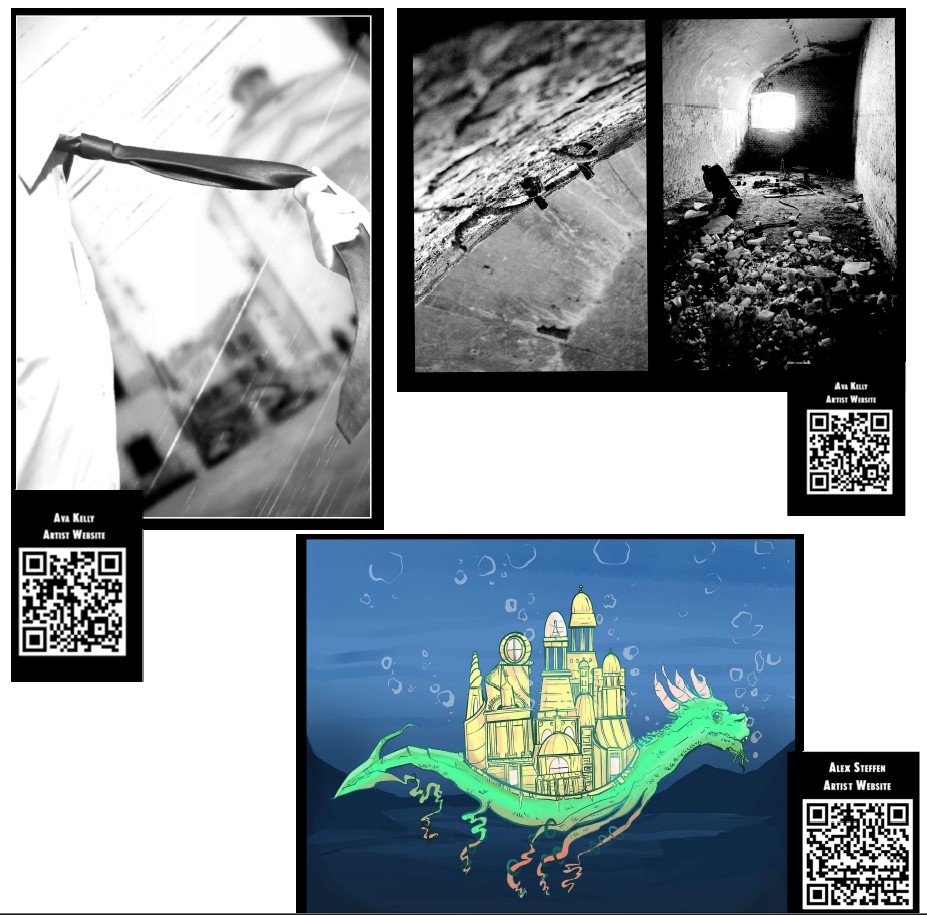
Thank you to the artists and the creatives who entered into our Image Prompt Contest. Check out the Contest Tab for all the details, including all of the submissions! Poster Award Winning Posts: Prompt A: “Wonder Why” by Ava Kelly: Prompt B: “Scythe” by Ava Kelly: Prompt C: Art by Alex Steffen
Some of our most anticipated events are still available – and waiting for you Meet our Special Guests HWA Lifetime Achievement Award and SFPA Grand Master of Fantastic Poetry Linda D. Addison and best selling author and Chicago Review of Books award winner Mikki Kendall in dedicated poetry and cozy tea sessions, among others! Both…
The 2024 Gen Con Writers’ Symposium program is now live! If you have already purchased your ticket to Gen Con, you can now select which events you would like to attend, between 5-19 May 2024. Our Gen Con Writers’ Symposium events are designed for writers, but everyone is welcome, and we hope you will consider…
Short-form video moves fast, but the people who consistently grow aren’t just “lucky” — they follow a repeatable discovery workflow. Instead of chasing yesterday’s viral clips, creators focus on emerging patterns: early signals in formats, hooks, pacing, captions, audio usage, and comment behavior. This post breaks down how creators actually find those patterns, how they validate them, and how to turn discovery into a sustainable content system.
What “Emerging Content Patterns” Really Mean
An emerging pattern is not a single trending video or a one-off spike. It’s a repeatable structure that starts appearing across multiple creators, audiences, or niches — often before the broader platform labels it a “trend.” Patterns can be subtle and still powerful.
Pattern Type
What It Looks Like
Why It Matters
Hook Structure
First 1–2 seconds use a question, contradiction, or outcome-first reveal
Improves retention and rewatch behavior
Pacing
Hard cuts every 0.5–1.5 seconds, minimal dead air
Matches short attention windows
Caption Style
Keyword-stacked captions, high contrast, short lines
Boosts comprehension without sound
Format Templates
“3 mistakes,” “before/after,” “POV,” “day in the life,” “rank these”
Easy to replicate and iterate
Engagement Triggers
Comment bait done naturally: “Which one are you?”
Increases comment velocity (distribution signal)
The key is to identify patterns while they are still emerging — when competition is lower and audiences haven’t developed fatigue.
How Creators Spot Patterns Before They Become Obvious
Creators who reliably find early patterns typically follow a routine that looks more like research than casual scrolling. They collect signals from multiple places, compare repetitions, and only then decide what to test.
1) Track Repetition Across Multiple Creators
A single high-performing clip can be random. Repetition is not. When you see the same hook style, pacing, or framing across different creators (and it keeps performing), you’re likely looking at a pattern instead of a coincidence.
Look for the same opening line structure appearing in different niches.
Notice if editing rhythm is converging (cut speed, zoom patterns, on-screen text cadence).
Compare comment sections for repeated questions or reactions.
2) Read Comment Signals Like a Dataset
Comments often reveal what the audience is actually responding to. If the comments repeatedly mention the same moment, claim, or visual cue, that element may be the pattern — not the entire video.
Confusion comments: indicate where you need clearer captions or faster context.
Identity comments: “This is so me” signals a relatable framing pattern.
Debate comments: indicate a polarizing topic structure worth testing.
3) Separate “Trend” From “Template”
A trend is often tied to a specific sound, meme, or moment. A template is a reusable structure that works even when the trend fades. Creators who grow long-term prioritize templates.
Discovery Tools and Why “Context” Beats Raw Metrics
Metrics alone can mislead. A video can spike due to external factors, paid pushes, or existing follower base. Creators need discovery tools that provide context: what repeated, where it repeated, and why it worked.
Many creators rely on tools like Yakored creative trend discovery tool to identify emerging short-form content patterns before they reach mainstream saturation. The advantage of a discovery-first workflow is simple: you don’t just see what’s popular — you see what’s forming.
Pattern visibility: spot repeating formats, not just top videos.
Creator-level signals: find which creator clusters are pushing a structure.
Early-stage discovery: notice rising patterns before they become overcrowded.
A Practical Pattern-Discovery Workflow You Can Repeat Weekly
Below is a realistic workflow you can run every week without turning content creation into a full-time research job. The goal is to create a small “pattern backlog” you can test systematically.
Weekly Routine (60–90 minutes total)
Collect: save 15–25 short videos that feel “similar” in structure (not topic).
Cluster: group them into 3–5 pattern buckets (hook, pacing, caption style, framing).
Extract: write a one-sentence rule for each bucket (e.g., “Outcome-first hook + 3 fast cuts”).
Test: create 2 videos using the pattern, swapping only one variable (topic or angle).
Review: compare retention points and comments; keep or discard the pattern.
Pattern Backlog Template
Pattern Name
Rule (1 sentence)
Test Ideas
Status
Outcome-First Hook
Show the result in 1 second, explain after
Before/after, “I tried X for 7 days,” quick reveal
Testing
Caption-Led Story
Captions drive the narrative even with sound off
Myth-busting, tutorials, quick lists
Validated
Comment Trigger Question
End with a natural forced-choice question
Rank options, “A or B,” “Which would you pick?”
Backlog
Common Mistakes That Make Creators “Late” to Every Pattern
Chasing only top videos: you see the end of the pattern lifecycle, not the beginning.
Copying content instead of structure: copying topic is easy; copying the winning template is what matters.
Testing too many variables at once: if hook, topic, pacing, and captions change together, you learn nothing.
Ignoring comments: you miss the audience’s real “why” behind engagement.
If you want earlier wins, your goal is not to be faster at copying — it’s to be better at identifying patterns while they are still forming.
Conclusion
Creators who consistently grow on short-form platforms treat trend discovery as a system. They look for repetition, extract templates, test with discipline, and keep a backlog of patterns that compound over time. If you build a discovery workflow and pair it with tools designed for context-first exploration, you can move earlier than the crowd — and create content that feels timely without being disposable.
FAQ
How do I know if something is an “emerging pattern” instead of a random viral hit?
Look for repetition across different creators and niches. If the same structure (hook style, pacing, caption format) appears repeatedly and continues to perform, it’s likely a pattern rather than a one-off event.
Should I follow trends or build templates?
Trends can boost short-term reach, but templates drive consistent growth. The best approach is to use trends as inputs while building reusable templates that work even when the trend fades.
How many times should I test a pattern before deciding it works?
At minimum, test the same pattern in 2–3 videos while changing only one variable (topic or angle). If retention and engagement improve consistently, keep it; if results are inconsistent, refine and re-test.
What matters more: views or retention?
Retention is usually the stronger signal for whether a pattern is worth repeating. Views can spike for many reasons, but retention indicates the structure itself is working.